

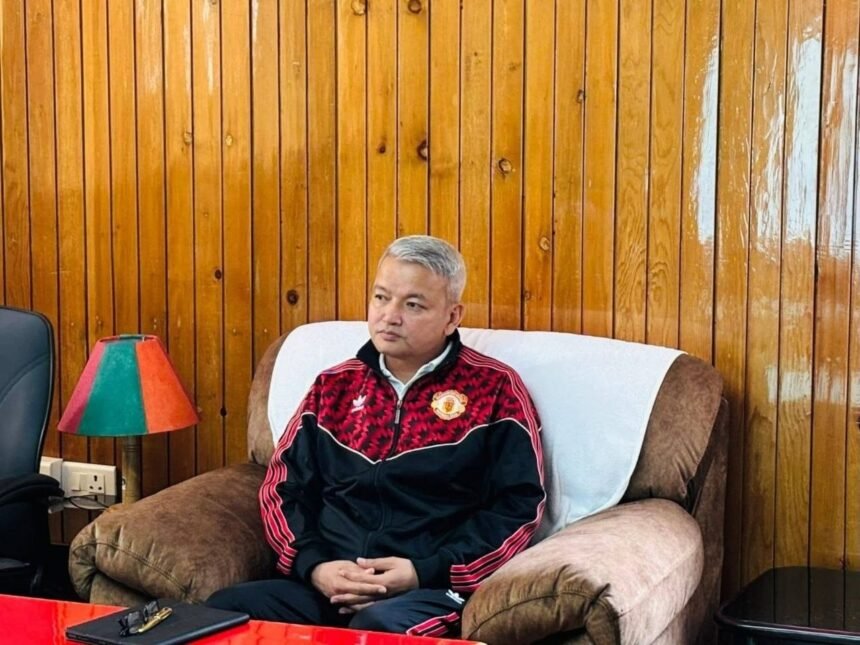
EDUCATION MINISTER RAJU BASNET CHAIRS MEETING WITH VIKRAMSHILA EDUCATION RESOURCE SOCIETY ON STRENGTHENING ENGLISH LANGUAGE TEACHING IN SIKKIM GOVERNMENT SCHOOLS
Gangtok, 12.06.2026
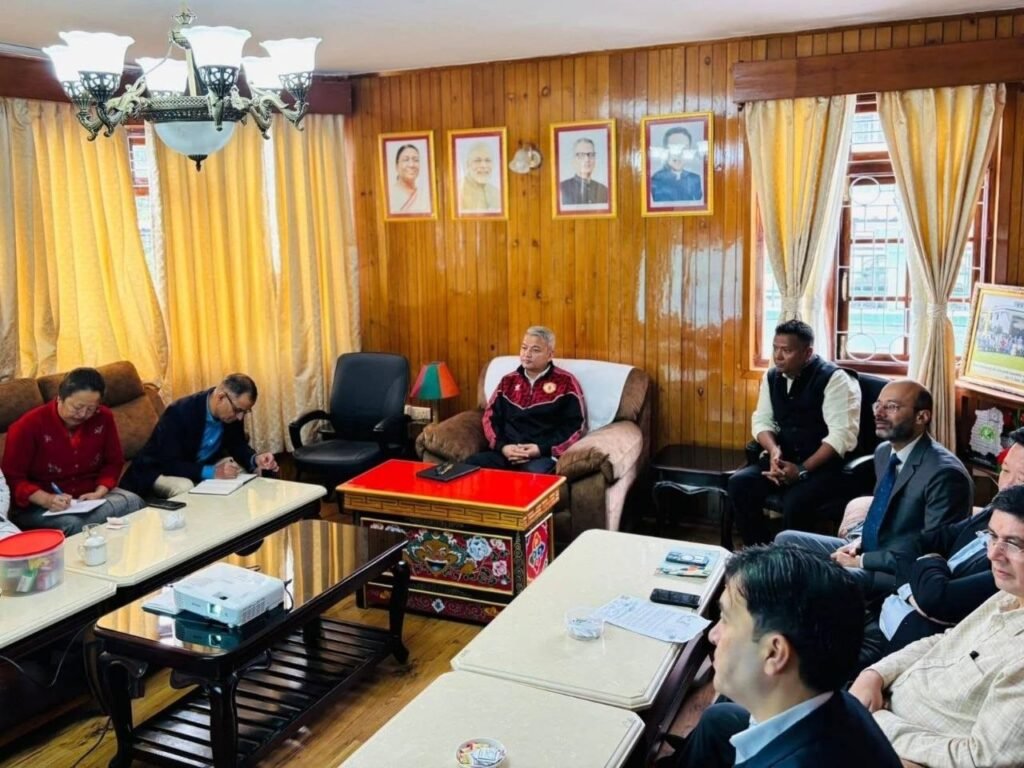
Minister for Education, Government of Sikkim, Raju Basnet, chaired a crucial meeting with representatives of Vikramshila Education Resource Society at his official residence in Gangtok on 12th June to deliberate on strategies for strengthening English Language Teaching (ELT) in government schools across the State.
The meeting was attended by Dr. Sandeep Tambe, IFS, Principal Secretary, Education Department; Tashi Chophel Lepcha, Secretary (School Education); A.D. Chhetri, Director (Language & Textbooks); Dr. Shanti Ram Adhikari, Director In-charge (SCERT); Tshering Lhamu Bhutia, Additional Director (SCERT); Dr. Hannah Yonzone, Joint Director (School Education); Rajiv Philip, Deputy Director (SCERT); and Dig Vijay Basnet, Deputy Director, Samagra Shiksha. Vikramshila Education Resource Society was represented by Shubhra Chatterji, Director, Vikramshila, along with her colleague.
Vikramshila Education Resource Society is a reputed educational organisation that has worked extensively across several states of India to improve foundational learning and strengthen classroom pedagogy. In the field of English Language Teaching, the organisation advocates a learner-centred and activity-based approach that views English not merely as a subject but as a language to be experienced, understood and acquired through meaningful interaction.
Its work emphasises oral language development, reading comprehension, vocabulary enrichment, communicative competence, joyful classrooms, teacher mentoring, development of contextualised teaching-learning resources and sustained academic support systems rather than one-time training programmes.
During the meeting, detailed discussions were held on the challenges associated with English language learning in government schools and the need for a comprehensive strategy to improve students’ reading, writing and communicative abilities.
The deliberations focused on understanding classroom realities, strengthening teachers’ confidence in spoken English, developing teacher guides linked to existing textbooks, creating classroom resource materials, building a cadre of master trainers, and establishing demonstration and mentoring support mechanisms to ensure effective classroom transaction and sustained improvement in learning outcomes.
The participants also discussed the importance of adopting evidence-based and context-specific interventions through close collaboration with SCERT and other academic institutions of the State. Emphasis was laid on conducting diagnostic studies in schools to understand existing challenges, creating low-cost and replicable teaching-learning resources, and fostering classroom environments that encourage active participation, communication and confidence-building among learners.
The attendees underscored the need for a phased and sustainable approach that strengthens the overall academic ecosystem while ensuring ownership of the programme by the State education system.
Minister Raju Basnet highlighted the State Government’s commitment to improving the quality of education in government schools and reiterated the importance of ensuring that every child acquires strong English language skills without compromising inclusivity and equity. He emphasised that enhancing English proficiency among students would not only improve learning outcomes but also boost confidence, aspirations and future opportunities for young learners.
The meeting assumes added significance in the backdrop of the recent one-day State Level Conference organised by the Education Department, wherein special emphasis was laid on improving English learning particularly reading, writing and communicative English in government schools.
It was observed that limited proficiency and confidence in English is increasingly perceived as one of the factors contributing to declining enrolment in government schools The proposed collaboration with Vikramshila is therefore aligned with the Department’s broader initiative to strengthen English language learning and restore public confidence in government schools by equipping students with essential communication skills required in the contemporary world.
After detailed deliberations, the participants agreed in principle to implement the proposed programme on a pilot basis in Soreng District, which is also an Aspirational District. The district was identified in view of its comparatively lower performance in relation to other districts in the recently concluded State Achievement Survey (SAS), thereby providing an opportunity to test and refine the intervention in a focused manner before considering future expansion.
The meeting concluded with a decision to hold further consultations and technical discussions in the coming days to develop an implementation framework and chart out the roadmap for the proposed programme.
