

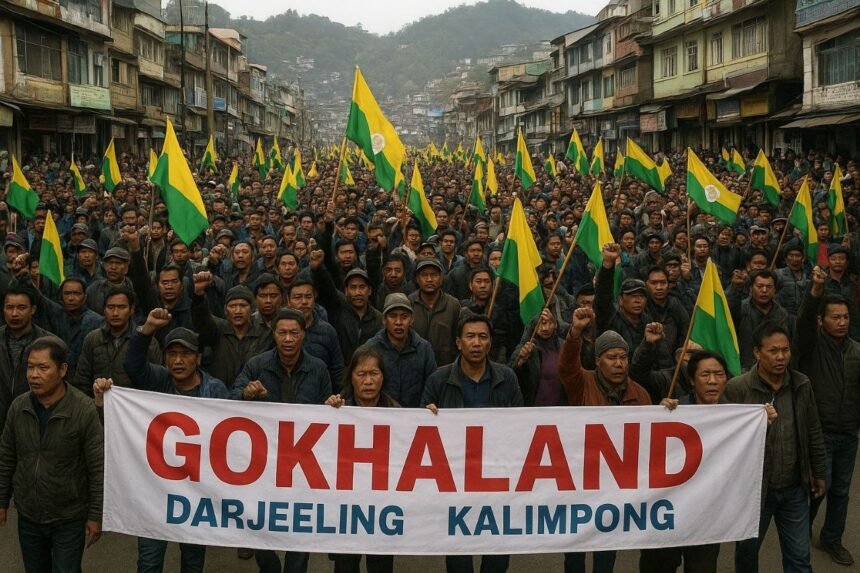
The Queen of Hills, Darjeeling, is a hill station and a northern district of West Bengal, India, that is a popular tourist destination for people worldwide. Its lush tea garden, toy train, breathtaking view of Khanchendzonga, pleasant climate and rich flora and fauna attract manypeople every year. However, visitors return with some indigestible pictures of Darjeeling, its congested and unmaintained roads, poor infrastructure, inadequate waste management, and poverty. The place, once upon a time, wasan educational hub not only for the entire Himalayan region but also for the outside world. Till the 1950s, Darjeeling received students from 28 nations (https://darjeelingheritage.com/). Unfortunately, people who visit Darjeeling often say that the place is as it was left by the British; development and progresshave stopped. Such comments from outsiders tarnish the image of Darjeeling and hurt the sentiments of its inhabitants, but that is the real picture: the Queen of Hills is currently. One striking question: what is wrong with Darjeeling and how can its glory be restored? This opinion sheds light on these two issues.
Many political pundits acknowledge that progress in a society will be ensured through good governance, the rule of law, justice, informed citizens, vibrant economic policies, and an effectivedistribution of resources. The individuals responsible for maintaining these services in a society include bureaucrats and political representatives within the democratic governance system. Later, bear greater responsibility due to mandates provided to them by the people through the democratic process.If they shirktheir responsibility, the public has the right to question them; educated people in society must hold them accountable to remind them of their duty. Unfortunately,Darjeeling lacksthis culture. In fact, once political leaders get mandates, they hardly turn their promises into reality, and people and society are left with unchanged social and economic conditions. This type of political culture favours a top-down approach to governance, securing the interests of business groups (entrepreneurs, contractors) and politicians.
Given a society where most people are illiterate and still struggling for daily wages, it is certain that they ignore the political sphere, but at this stage,it is the responsibility of the leaders of a society to socialise them politically. According to Almond and Verba, political parties have two types of functions: (i) Input functions, such as political socialisation, interest articulation, interest aggregation, and political communication, and (ii) output functions like rule-making, rule application, and rule adjudication. All these functions of the political party ensured good governance, the rule of law, informed citizens, political stability, robust economic policies, and an equitable distribution of resources, all of which together contribute to societal progress. Moreover, if the political party and the leaders follow opposite paths, then only a section of society will benefit,but the overall progress of society will remain stagnant.Then, what kind of political culture do we have? Let’s have a quick look.
Political Pictures of Darjeeling
The politics of Darjeeling is largely rooted in aspirational nationalism and cultural autonomy (Subba, 1992), which often seek solutions through alliance-oriented politics (Lama, 2005). Professor Arora (2007) labelled the political culture of Darjeeling as negotiated pluralism (multiple cultural, ethnic and religious, or political groups coexist and clash), which resulted in fragmented electoral behaviour and coalition politics. In fact, the divergent aspirations and agendas of different ethnic groups and parties, which present varying historical and cultural perspectives, such as “Nye Mayal Lyang,” “Greater Nepal,” “Gorkhaland,” and “Merger with Sikkim,” contribute to the fragmented political consensus. Not only that, but also a coalition with national parties, contesting for the chair of regional offices (such as the Gorkha Hill Territorial Council and Gorkhaland Territorial Administration 1 and 2.0), and, most importantly, addressing the ignorant voters of the region. Altogether, the politics of Darjeeling make it very complicated and confusing for students of political studies.
The political participation is very fragmented and limited to voting.A party do not require a clear agenda and vision during an election to attract a large number of voters in Darjeeling. The people cast their votes for a candidate under the influence of local leadership, the social image of the leaders, historical alienation from the party, and immediate benefits such as food, gifts, money, and shelter. To ensure participation in the electoral process and to reject all the contesting candidates, the “NOTA” option will be made available to voters.However, the majority of voters in Darjeeling perceived that casting a vote for ‘NOTA’ does not count in government records, resulting in the choice of the candidate among the worst. The lack of understanding about the democratic value of a single vote and the possible consequences it can bring for the next five years in their lives is a harsh reality for the voters of Darjeeling.
When the public, in general, is convinced through established political culture that the political process is no longer a reliable vehicle for societal changes, then they pay the least attention to the functioning and activities of a political party. In fact, they are often viewed with suspicion as corrupt, dishonest, and social parasites. In Darjeeling, politics has changed significantly from a ‘gentle task’ to the business of unwise, unaccountable, and morally disabled people. The reason behind the downgraded images of political leaders is due to the negative experiences people have had with the political system. For most people, politics is a dirty game in the sense that it involves deception, lying, bribing, lynching, threatening, andattackingthe members of the opposition party. Otherwise, politics was always a vehicle through which society could be governed, promote the welfare and provide security of people in the best possible manner. Then, a fundamental question arises-who is responsible for establishing such a culture in Darjeeling? Let me explain through scholarly viewpoints.
In the Vedic society, a Rajan used to be the supreme leader of the Jana (Tribe), and he must have possessed the following qualities: valour (martial ability), Dharma (righteousness and Social Order), generosity, and protectiveness. The societyestablished by such wise and generous leaders had alwaysembodied justice and inclusiveness, supported by the rule of law, equality, and rights. If we see outside Indian society, Plato’s idea of the philosopher king and Huangdi of Confucian traditionpossess similar characteristics in terms of their ability. A common attribute can be found among these leaders: first, they were extensively wise and virtuous, and second, they could govern the state with moral legitimacy. The philosopher king of Plato’s Republicis a person who loves wisdom and truth above all else; that is why he is called philosopher king. The Greek word ‘Philo’ means love or affection, and ‘Sophy’ means Wisdom or knowledge. It denotes that governing a society and shaping the fate of people has always been the business of wise and responsible people. And the culture established through their leadership always pushessociety towards progressive paths.
Many (Almond & Verba, 1963; Putnam, 1993; Inglehart & Welzel, 2005) have argued that historical experiences, social structures, political institutions, educational systems, media influences, and the role of political leadership shape the political culture of a society. Antonio Gramsci, a neo-Marxist thinker and the author of “Prison Notebook”, said that a political leadership plays a central role in constructing and maintaining a specific political culture that supports the hegemony. ‘Hegemony’signifies a condition in which the worldview of the dominant group becomes an accepted norm in a society through an unnoticed consensus. If this is the case, then political leaders play a crucial role in shaping the political culture of a society to a larger extent; therefore,the leaders of Darjeeling are responsible.The lack of education and political awareness leads to the establishment of a favourable political culture in a society, as Gramsci argued.Thus, there is no doubt thatthe political leaders of Darjeeling are responsible for establishing a political culture where people perceive leaders as social parasites instead of their representatives, viewing the entire political process as a sphere of irrationality. In totality, politics in Darjeeling is perceived as a legitimate channel of corruption, and the easiest way to earn name and fame, albeit full of uncertainties.
Possible Way Out
The wide range of problems is there in the politics of Darjeeling,and most prominent among them are (i) illiterate voters who lack political consciousness, (ii) interest-driven politics, (iii) lack of leadership quality, and (iv) an absence of intellectual involvement. Nurturing the political consciousness takes longer than expected; in fact, it is uncertain and mostly depends on the political will of the leaders. Interest-driven politics cannot be replaced by agenda-based politics when the ordinary people only understand the language of immediate welfare (money, food, small contracts). Lack of leadership cannot be moulded unless and until the educated section of society participates in politics in a strict sense. Then, the only possible way is to give educated people in society a space within political parties and to allow political parties to function under their guidance. In the political history of Darjeeling, the educated section of society has consistently kept itself aloof from politics, largely due to tragic historical experiences, social stigma associated with politics, and the unwillingness of political leaders to serve under the guidance of educated individuals.
In the past, many educated individuals, such as Prof. Mahendra P. Lama and Dr Harka Bdr. Chhetri, Dr Manish Tamang, and otherstried to mobilise people based on their knowledge and experience, but they failed. The major reason is a lack of political socialisation, and the inability of voters to understand the intellectual and logical viewpoints of educated people. This signifies that an educated group remaining outside the ruling party and mobilising people towards the betterment of society is not at all possible in Darjeeling. Instead, the ruling party must implement structural changes within itself and establish an educated wing that serves as a separate monitoring body, overseeing every aspect of the political party’s operations. The task of the educated section of society can be categorised into three: recommending agendas that bring about structural changes in society (long-term goal towards development), fulfilling the immediate common desires of the people, and all those measures that secure the land and the people from encroachment and identity crisis. Educated people outside the party must work towards political socialisation through their writings, in the form of stories, novels, academic articles, poems, and many more. In the long run, such development may address the problems highlighted above in the politics of Darjeeling, and only then can society and the people prosper in the ‘Queen of Hills’.
Author: SAMIR SUBBA (PhD Scholar)
Department of IR & Politics
Central University of Kerala, India
Email: zamdallay@gmail.com
