

PRESS RELEASE
New Delhi, September 21: The inaugural edition of the Himalaya Commons Dialogue, a convening by the Council for International Economic Understanding (CIEU) and Dalberg Advisors under the aegis of the Bharat Climate Forum (BCF), was opened by Shri Ashwani Mahajan, President, BCF, National Co-Convener, Swadeshi Jagran Manch and Board member, CIEU; Smt. Meenakshi Lekhi, Convener, BCF and Former Minister of State for External Affairs and Culture, Government of India, and Shri Gopal Arya, National Convenor, Paryavaran Sanrakshan Gatividhi, Rashtriya Swayamsevak Sangh.
Against the backdrop of the recent flash floods in Nepal, the dialogue underscored the mounting pressures on the Himalayan ecology, from cryosphere degradation to rapid urbanization. The high-level discussions brought together central and state governments, scientific institutions, and multilateral agencies to address questions around ecological security and economic resilience across the Himalayas, and how cross-border cooperation can address the challenges faced by the region.
“The Himalayas have always been a high-risk landscape,” said Jagjeet Sareen, Regional Director for Asia Pacific, Dalberg Advisors. “As we have repeatedly seen in recent times, climate change and unplanned development interacting with that instability has grave consequences. Development is not optional for mountain communities, but can we deliver that development without exceeding the region’s ecological thresholds? This series is meant to arrive at actionable solutions to this question, and explore how measures such as binding development limits, terrain-responsive infrastructure, non-negotiable safeguards and genuine community participation can make growth and resilience compatible rather than competing goals.”
The Indian Himalayan region alone contains ~36% of the country’s forest cover and contributes ~63% of its water-flow budget. As global temperatures rise, the area is increasingly prone to extreme climate, affecting rainfall, water supply and crop viability. As the panelists pointed out, the first step is to better understand the ecology of the region and the signals sent by landscape features such as glacial lakes.
“We plan based on environmental impact assessment reports,” said Dr Anil Kulkarni, Distinguished Scientist, Divecha Centre for Climate Change, Indian Institute of Science, Bangalore. “In the high Himalayas, nature is changing. And changing nature is also affecting (development projects such as) hydropower. So, a changing cryosphere report needs to be done.” Shri S.P. Sati, Professor and Head of Department of Basic and Social Sciences, VCSG Uttarakhand University of Horticulture and Forestry pointed out ecological features that need to be studied to effectively assess climate risk. “Hanging glaciers are a risk and there are thousands of hanging glaciers,” he said. “Mapping of each hanging glacier needs to be carried out.”
Mr Safi Ahsan Rizvi, Former Advisor, National Disaster Management Authority, stressed the importance of “coordination and planning” among government agencies to preemptively tackle the challenges of mountain development, as opposed to reacting to natural disasters.
While some parts of the Himalayan region face the challenge of out-migration, resulting in an overall loss of mountain livelihood, other parts face the consequences of urbanization and intense tourism.
Shri Satish Kashinath Marathe, Former Director, Central Board, Reserve Bank of India; Founder Member, Sahakar Bharati, recommended encouraging the cultivation of local produce. “We do need small processing units for agricultural products and medicinal and aromatic plants,” he said. “Horticulture is going to be a major gamechanger. We should focus on not just growing fruit but helping local people to process it. This area needs special capacity building and training activities.”
Addressing the problem of rampant construction in mountains towns and the burden this has placed on infrastructure, Shri Bhaskar Khulbe, Former Advisor to the Honorable Prime Minister, said that it’s important to work with local communities, who have generational knowledge about the kind of architecture that’s compatible with the region’s terrain. Shri Ramesh Negi, President, Integrated Mountain Initiative; Former Chief Secretary, Government of Arunachal Pradesh, added that caution needs to be exercised while building hydro projects as these place immense pressure on the ecology.
Shri P. Subramanyam, Former Principal Chief Conservator of Forests and Head of Forest Force, Government of Arunachal Pradesh, held the state up as an example of how government can advance resilience. “In Arunachal, climate resilience is embedded in government structures,” he said. “Climate-oriented strategies are distributed across government departments. This integrated cross-sectoral approach is proving effective, rather than one department being held responsible.”
Crucially, it was pointed out that the Himalayas need to be viewed through a regional lens as the area crosses boundaries. The region is the source of ten major Asian river systems; it supports around 240 million people in the mountains and 1.65 billion downstream. As a result, countries need to collaborate over early-warning systems, share hydrological data and jointly engage in scientific research to mitigate the increasing risks of extreme climate events. As Shri Hemang Jani, Senior Advisor to the Executive Director (EDS12), World Bank Group, pointed out, “We have to start looking at resilience as a regional public good. We need to start thinking of problems and solutions in a regional manner.”
Shri Shyam Saran, Former Foreign Secretary; Former Indian Ambassador to Nepal and Prime Minister’s Special Envoy on Climate Change said: “We are treating some of these natural assets as if they were private property. But none of the political issues that divide us will mean very much when (a crisis occurs).”
The Alpine Convention presents a model of what cross-border cooperation can look like. “The most important thing is to build a structure that helps politicians build trust,” said Alenka Smerkolj, Secretary General, Alpine Convention. “Political cooperation is always difficult. It’s much better to have a small amount of funding to establish a secretariat and then build.”
The region already has an organization that facilitates cooperation on sustainable development across eight countries: the International Centre for Integrated Mountain Development (ICIMOD). The audience heard from Shri Pema Gyamtsho, Director General, ICIMOD, who said that the need to strengthen trans-boundary cooperation is more urgent than ever.
There is potential for regional collaboration and learning through other institutions as well. Ms Ranjini Mukherjee, Director-Research, Knowledge Management and Capacity Development, Coalition for Disaster Resilient Infrastructure (CDRI) told the panel about CDRI initiatives such as helping Bhutan assess its earthquake preparedness. “This methodology has the potential to get replicated across countries,” she said.
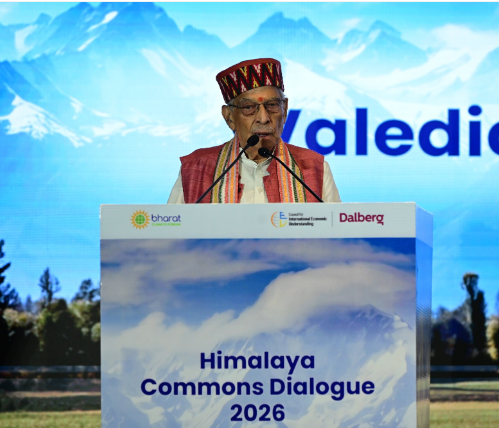
Veteran BJP leader Shri Murli Manohar Joshi had the final word in his valedictory address. “We need to think about our ways of life,” he said. “Are we putting ourselves in danger? Can we make infinite progress with finite resources? Our ethos is to consume as much as you need. But our current culture is the opposite. The world is out of balance. We need to bring balance back into the world.”
Press Contact:
- Jacqui Hocking, M: +65 84545945
- Pronoti Datta, M: +919821932723
- press@dalberg.com
About Bharat Climate Forum
The Bharat Climate Forum is a national platform in collaboration with Dalberg Advisors and Council of International Economic Understanding (CIEU), that brings together government, industry, and global partners to accelerate India’s transition to a net-zero, self-reliant, and developed economy by 2047. Through convenings, policy inputs, and coalition building, BCF works to indigenize cleantech manufacturing, strengthen industrial ecosystems, and position India as a global leader in climate-smart growth.
About CIEU
The Council for Inclusive Economic Understanding (CIEU) is an independent think tank based in New Delhi. CIEU conducts in-depth research, hosts inclusive dialogues, and develops forward-thinking solutions aimed at reconstructing economies rooted in equity and citizen empowerment.
About Dalberg Advisors
Dalberg is a professional services firm that puts impact at the heart of critical decision-making.
Dalberg recognizes that optimizing for social and environmental impact is a deeply human science, navigating a maze of behaviour, politics, technology, and culture. For over two decades, the firm has delivered projects that take on this complexity, while offering clarity that has enabled action.
Serving those who serve the world, Dalberg has, over the past 25+ years, partnered with 1,600+ leading organizations across nearly all sectors and fields.
