

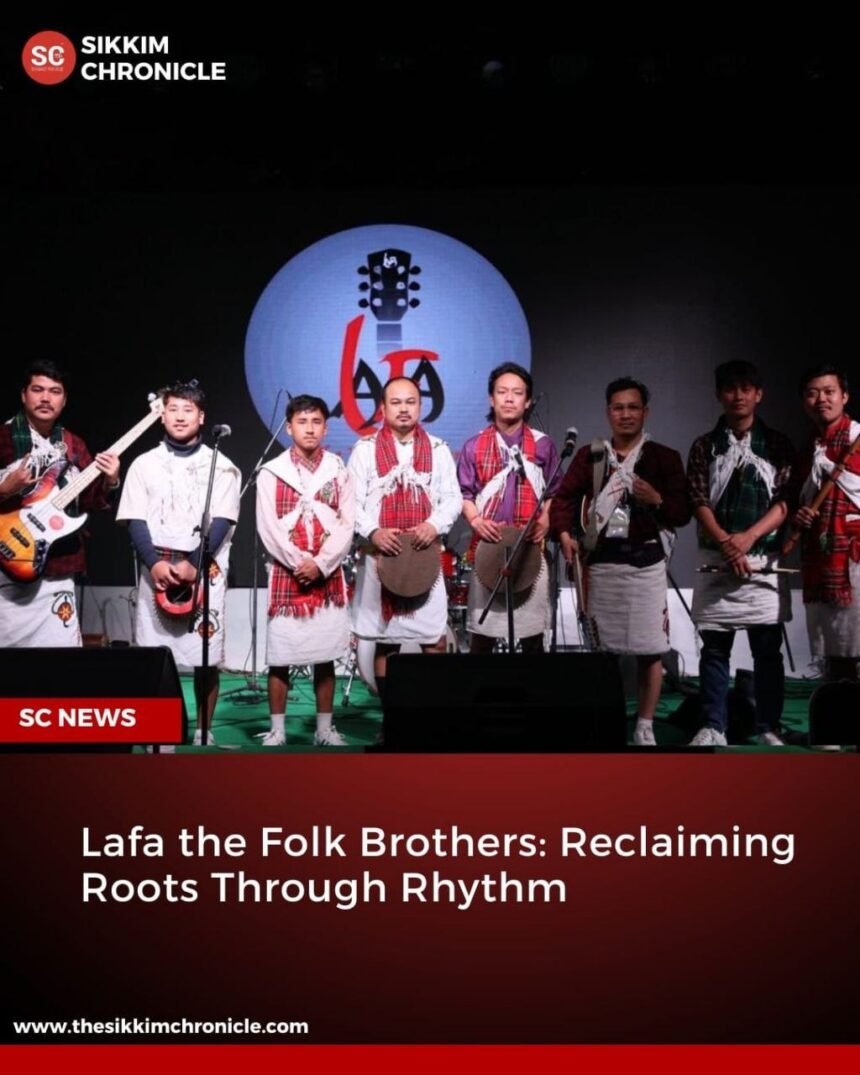
In an age where algorithms shape our playlists and global trends dictate what we hear, a quiet yet powerful musical movement is emerging from the hills of West Sikkim. It is not driven by commercial ambition or viral fame, but by something far more enduring—the search for identity. The band Lafa the Folk Brothers stands at this intersection, asking a simple yet profound question: What does it mean to belong, and how do we carry that belonging forward?
The formation of the band is not merely a story of musicians coming together; it is a reflection of a deeper cultural instinct. For the members, music was never an acquired skill—it was inherited. It lived in the rhythms of their village, in the voices of their elders, in the echo of traditional instruments that have long narrated the story of the Mangar people. From their earliest days, they were not just listeners but participants in a living tradition.
Their home, Suldung in West Sikkim, is more than a geographical location—it is a cultural landscape. A village where the Mangar language transcends community boundaries, spoken even by Lepchas and Rais, it embodies coexistence and shared heritage. Yet, like many such spaces, it stands at the edge of transformation. Modernity seeps in quietly, often overshadowing the very traditions that once defined identity.
It is here that Lafa the Folk Brothers finds its purpose.
The name itself is a statement. “Lafa,” meaning friend in the Mangar language, signals connection; “folk” anchors them in tradition; and “brothers” speaks to unity. Together, it becomes a philosophy—a commitment to preserve while evolving. Their music is not an attempt to resist change but to shape it meaningfully.
At the heart of their work lies a deliberate choice: to let traditional beats lead. Genres like hurrah, sorati, salaijo, ghasi, bhumey, and kaura are not relics for them; they are living, breathing forms. Modern instruments—guitars, drums, bass—enter not as replacements but as companions. This inversion of hierarchy is crucial. In a world where “fusion” often dilutes tradition, the band reclaims it as the foundation.
Yet, their journey also reflects a generational truth. They are as much children of rock and metal as they are of folk traditions. This duality is not a contradiction but a reality of contemporary identity. The excitement they felt imagining a madal blending with electric guitar or a khaijari syncing with drumbeats reveals a deeper creative impulse—the desire to make tradition speak in a language the present understands.
Language, too, becomes a site of negotiation. By prioritizing Mangar Dhut while incorporating Nepali, they navigate the delicate balance between authenticity and accessibility. It raises an important question: Can a culture survive if it is not understood beyond its own community? Their answer seems to be one of inclusion without erasure.
Their performances at events like the Kuju Festival, Jorethang Maghey Mela Creative Hub 2.0, and Red Fest at M.G. Marg are not just showcases—they are acts of cultural assertion. Each stage becomes a space where forgotten rhythms are reintroduced, where audiences are invited not just to listen but to remember.
But beneath the applause lies a more sobering reality.
The challenges they face—limited finances, lack of proper instruments, the struggle to balance work and passion, and even the physical distance between members—are not unique to them. They are symptomatic of a larger issue: the undervaluation of grassroots cultural expression. When artists striving to preserve heritage must struggle for basic resources, it forces us to confront an uncomfortable truth about what society chooses to prioritize.
And yet, they persist.
Encouraged by the response they receive, they continue to create, to research, to refine. Their journey is not just about making music; it is about rediscovering who they are. In doing so, they invite their listeners to embark on the same journey.
Lafa the Folk Brothers is more than a band. It is a reminder that culture is not static—it must be lived, questioned, and reimagined. Their story challenges us to rethink our relationship with tradition. Do we preserve it as it is, risking irrelevance? Or do we adapt it, risking dilution? Perhaps, as they demonstrate, the answer lies somewhere in between.
In their music, the past does not compete with the present—it converses with it. And in that conversation, something timeless is born.
