

Article by Nirmal Mangar
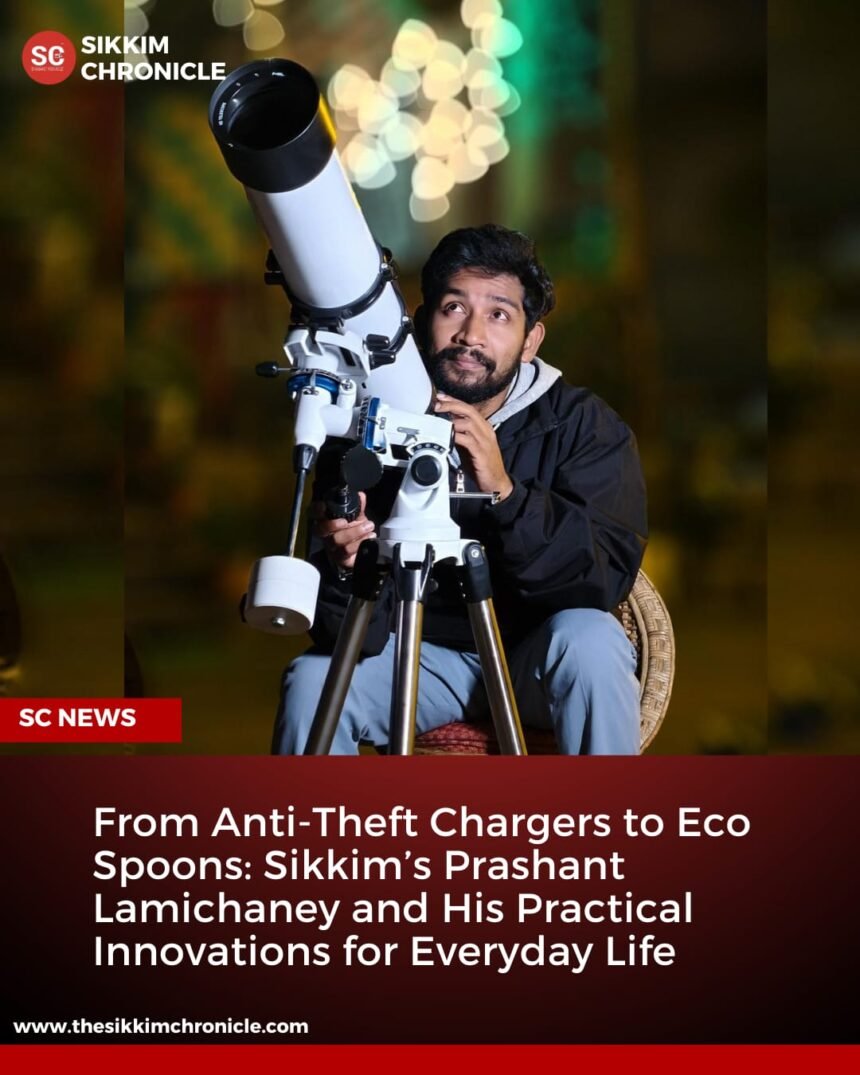
Hailing from Temi Tarku in South Sikkim, Prashant Lamichaney represents a new generation of grassroots innovators whose ideas are shaped by lived experience, curiosity, and a deep connection to community life. Growing up in a culturally rich and resilient rural environment, his childhood was defined not only by textbooks, but by observation, experimentation, and hands-on learning.
“Temi was more than my village. It was my first classroom, laboratory, and source of inspiration,” Prashant says.
His scientific journey began at Temi Senior Secondary School, where teachers encouraged curiosity beyond the syllabus. A strong influence was his chemistry teacher, whose laboratory sessions sparked his fascination with experiments and real-world applications of science. Even as a Class 6 student, Prashant spent free periods in laboratories, learning through observation, questioning, and trial.

His interest gradually expanded into electronics. Working with wires, circuits, and discarded components, he began building simple machines, model vehicles, and functional devices. Teachers nurtured this spirit of experimentation, guiding him toward more complex projects such as robotic arms, rescue robots, automatic street lights, and other utility-based innovations during SUPW activities. His exposure to computer hardware and system assembly strengthened his ability to design, document, and refine ideas, earning him the title “Junior Scientist of the School” in 2012.
Support at home played an equally vital role. His father, Dhan Bahadhur Lamichaney, a TV and electronics mechanic, unknowingly became his first technical mentor, while his mother, Aruna Lamichaney, provided constant encouragement. Surrounded by damaged appliances and electronic scraps, Prashant learned by dismantling, repairing, and rebuilding.
“Mistakes were common, but discouragement was never part of the process,” he recalls.
Over time, Prashant developed a series of practical, purpose-driven innovations addressing everyday challenges. These include an Anti-Theft Charger inspired by a mobile theft incident during train travel; an Eco Spoon combining a spoon and napkin into a single sustainable unit; an Anti-Careless Mask developed during the COVID-19 pandemic; Doko-based innovations to reduce physical strain on traditional load carriers; a Khukuri safety innovation preserving cultural significance while improving usability; a retractable sheet cum hanger to prevent clothes from getting wet in bathrooms; and a public toilet usability innovation focused on hygiene and safety. Several of these innovations are currently under patent filing, and technical details remain confidential.
Participation in state, regional, and national science exhibitions marked a turning point in his journey. One of his notable projects, the Wireless Switch Control System, earned recognition across multiple levels, strengthening his confidence and communication skills. Along with his classmates, and with the support of Shri Yuvraj Bista, Shri Basu Dhakal, and Dr. Hem Prasad Subedi, Prashant worked collectively on innovative ideas that led to the successful establishment of an Atal Tinkering Lab (ATL) at his school.
This achievement went beyond infrastructure. It helped create a culture of innovation, experimentation, and problem-solving among students—an experience that reinforced Prashant’s belief in mentorship and collaboration as catalysts for meaningful innovation.
A defining transformation in his journey came later with the guidance of Dr. Mukul Ma’am.
“Everything changed after I met Dr. Mukul Ma’am. Her encouragement played a transformative role in my journey. She believed in my ideas at a time when they existed only in my mind and helped bring my innovation spirit back to life,” Prashant shares.
With her mentorship, he began converting concepts into actual prototypes and gained a deeper understanding of intellectual property. She also supported him in initiating patent filing, with guidance from her friends at PATENTshala. This phase brought renewed clarity, direction, and energy to his work.
Today, Prashant follows a focused and structured approach, developing three to four innovative ideas and prototypes every month.
Community involvement remains central to his innovation process. Local users are often the first to test his prototypes, and their feedback plays a critical role in refining designs. Farmers, workers, students, and everyday users openly share their experiences, helping him identify gaps that technical testing alone cannot reveal.
“Community feedback keeps my work grounded in real needs rather than assumptions,” he explains.
By observing how people use a prototype, listening to their suggestions, and sometimes co-creating solutions with them, Prashant ensures his innovations are comfortable, durable, affordable, and socially accepted.
Looking ahead, his long-term vision is to build people-centric and sustainable solutions that address everyday problems at the grassroots level. He aims to bridge traditional knowledge with modern design while promoting environmental responsibility, safety, and efficient use of resources.
Beyond creating products, Prashant hopes to build an ecosystem where young innovators—especially from rural and semi-urban backgrounds—are encouraged, mentored, and empowered to solve local challenges through education, community engagement, and responsible design.
His message to students and aspiring innovators is simple yet powerful:
“Don’t wait for the perfect moment or perfect resources. Every meaningful innovation begins with a small step, a simple question, or even a failed attempt. Believe in your curiosity, learn from mistakes, seek guidance, and start with what you have. Innovation belongs to anyone who has the courage to begin.”

