
By NIRMAL MANGAR
As India marks ten years of the Startup India movement, the country’s innovation story is no longer confined to Bengaluru, Delhi, or Mumbai. Increasingly, the narrative is shifting towards regions that were once considered peripheral to the startup economy. In this evolving landscape, the Atal Incubation Centre – SMU Technology Business Incubator (AIC–SMUTBI) at Sikkim Manipal Institute of Technology (SMIT), Majhitar, stands out as a transformative institution that has fundamentally reshaped the entrepreneurial ecosystem of North East India.
Established in September 2018, AIC–SMUTBI became the first Atal Incubation Centre in the North East, at a time when the region lacked a strong, institutionally backed incubation anchor. For local entrepreneurs, innovation often came with a painful trade-off—either relocate to metropolitan startup hubs or struggle in isolation. AIC–SMUTBI was conceived to end that dilemma.
Before the incubator’s launch, the North East faced deep-rooted challenges: limited access to mentorship, inadequate innovation infrastructure, weak investor networks, fragmented support mechanisms, and a severe shortage of early-stage capital. These gaps created what many founders describe as the “valley of death”—the fragile phase between idea validation and market readiness where most startups fail.
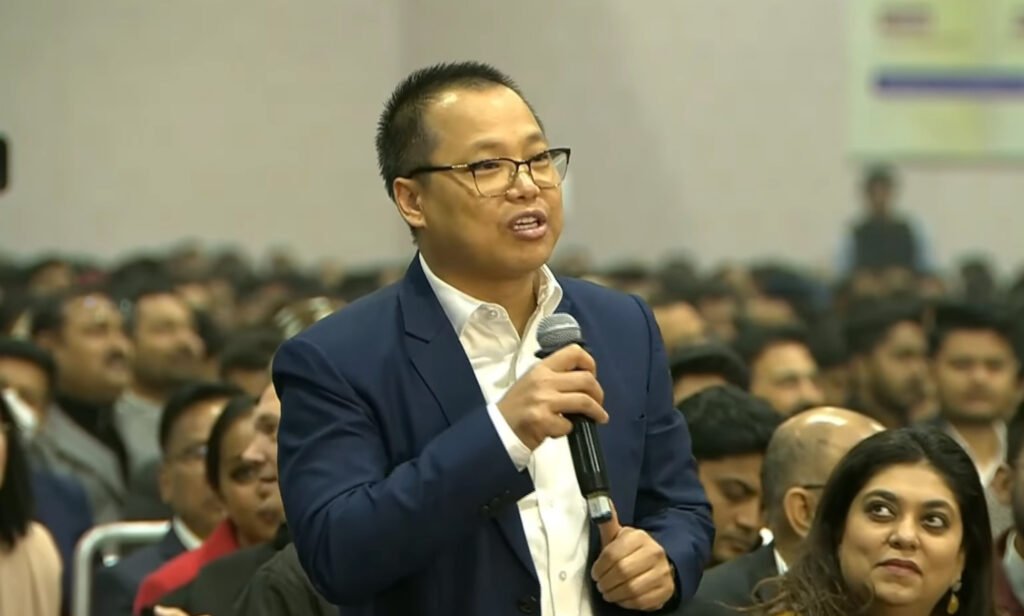
“The region did not lack ideas or ambition,” said Mr. Tej Chingtham, CEO of AIC–SMUTBI.
“What it lacked was a coordinated, credible ecosystem that could support founders through the entire startup lifecycle. Our mission was to build that system from the ground up.”
Anchored within a leading technical institution, AIC–SMUTBI brought together physical infrastructure, structured incubation programs, and a strong governance framework under the aegis of NITI Aayog, Government of India. Over time, it evolved into a central node connecting policy, industry, investors, and entrepreneurs.
Since its inception, AIC–SMUTBI has incubated 184 startups, spanning technology, agritech, sustainability, healthcare, social innovation, and deep-tech domains. More importantly, it has helped these ventures overcome the most critical barrier—access to capital.
Through multiple funding channels, including direct AIC support and partner agencies, the incubator has facilitated over ₹45 crore in investments. This capital infusion has enabled startups to move beyond prototypes, secure pilots, and enter national and international markets.
“Funding is not just about money,” Mr. Chingtham noted.
“It is about validation. When a founder from the North East raises capital, it sends a powerful signal that innovation from this region can compete anywhere.”
Recognising that capital alone cannot build sustainable startups, AIC–SMUTBI placed strong emphasis on mentorship. Today, the incubator is supported by a 48-member mentor board, comprising experienced professionals from technology, business strategy, finance, law, policy, and global markets.
This structured mentorship has addressed a long-standing gap in the region, where early-stage founders often lacked access to seasoned advisors capable of guiding them through product-market fit, compliance, fundraising, and scaling.
“We have institutionalised mentorship,” said Mr. Chingtham.
“Founders don’t just receive advice—they receive direction, accountability, and long-term guidance.”
One of AIC–SMUTBI’s defining strengths has been its ability to connect regional startups with national and global platforms. Incubated startups have engaged with and raised support under programs run by Meta, Google, Amazon, Hero MotoCorp, Adani Energy, and Numaligarh Refinery Limited (NRL), among others.
These partnerships have provided startups with access to pilots, market validation, cloud credits, enterprise customers, and global best practices—resources traditionally inaccessible to founders operating outside metro ecosystems.
Beyond India, AIC–SMUTBI has built a strong international innovation network, with ecosystem partnerships extending to Skolkovo (Moscow), MSG Foundation (Riyadh), and tGELF, opening pathways for cross-border collaboration, market entry, and knowledge exchange.
The incubator’s work is further strengthened by its engagement with key ministries, including the Ministry of Commerce & Industry, Ministry of Electronics & Information Technology, and the Ministry of External Affairs, in addition to being fully supported by NITI Aayog. This multi-ministerial alignment has enabled AIC–SMUTBI to operate at the intersection of innovation, policy, and economic development.
Crucially, AIC–SMUTBI has also amplified startups addressing local and regional challenges—from agriculture and sustainability to social impact and livelihood generation. These ventures, often overlooked by mainstream accelerators, have found tailored support that respects local context while enabling scalability.
“Our success is not just measured by valuations,” Mr. Chingtham emphasised.
“It is measured by relevance—by how many startups are solving real problems for real communities.”
As India enters the next phase of its startup journey, AIC–SMUTBI offers a compelling model for decentralised, inclusive innovation. By anchoring global networks within a regional ecosystem, it has proven that geography need not define opportunity.
A decade into Startup India, the story of AIC–SMUTBI is ultimately about belief—belief in regional talent, belief in structured ecosystem-building, and belief that innovation, when nurtured locally, can create impact far beyond its origins.