

Chh
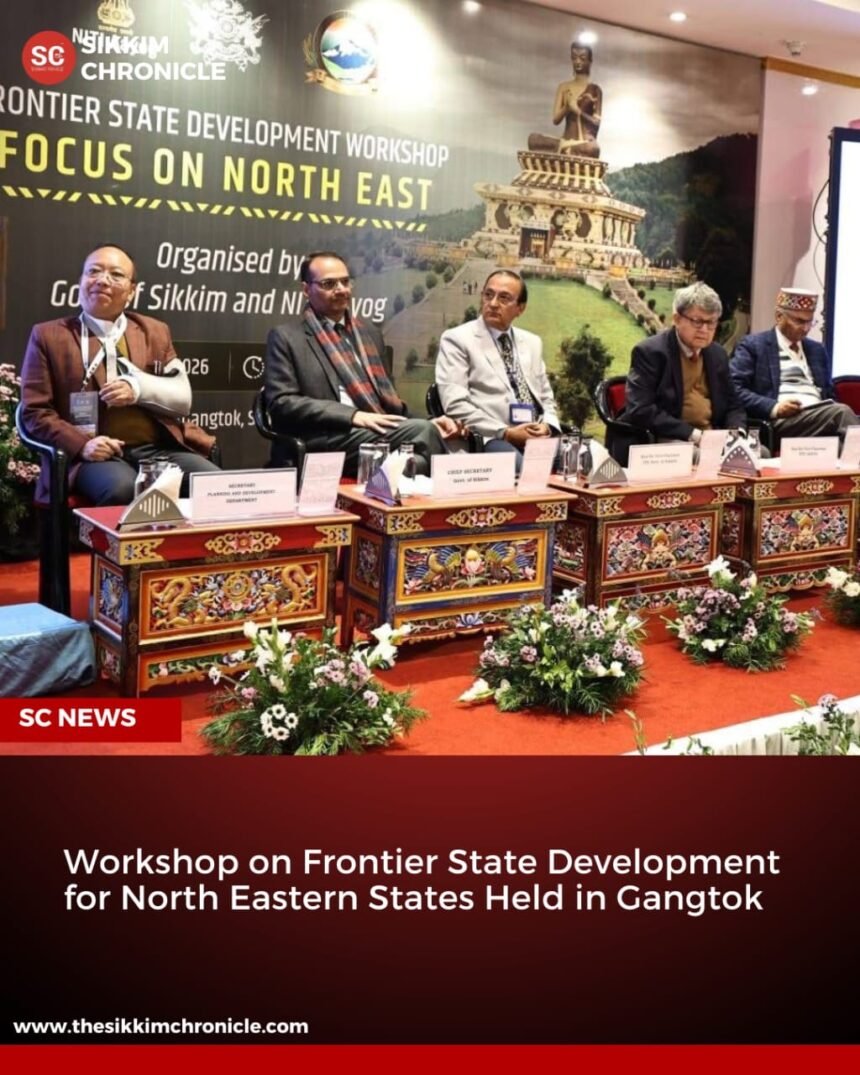
Gangtok, January 14 (IPR): A workshop on Frontier State Development, Focus on North East was organised by Government of Sikkim in collaboration with NITI Aayog at a local hotel in Gangtok, today.
The workshop aimed to identify strategies for the holistic development of frontier areas by integrating health, livelihoods, connectivity, and security. It also sought to strengthen organic agriculture and green economy linkages among the North-Eastern states, build a regional innovation network under the Atal Innovation Mission (AIM) to promote inclusive entrepreneurship, and create a platform for inter-state collaboration by showcasing successful models from Sikkim, Arunachal Pradesh, Nagaland, Mizoram, Manipur, Meghalaya, Assam, and Tripura. Additionally, the workshop focused on developing a policy roadmap and a framework for regional cooperation to advance frontier region development.
In his keynote address, Vice Chairperson, NITI Aayog, Mr Suman K Bery, outlined the objectives of NITI Aayog and reflected on the challenges and opportunities of the North Eastern region in the context of Viksit Bharat. He appreciated the state’s cleanliness and the prevailing sense of calm.
He elaborated on Sikkim’s potential to position itself across various platforms on the global stage and described the state as a central catalyst in guiding other states towards the vision of Viksit Bharat. He emphasised the importance of aspiring to institutionalise quality and highlighted the need to bridge the gap between performance and aspiration.
The Chief Economic Adviser to the Government of Sikkim, Dr Mahendra P Lama, stated that the North East Region Vision 2047 formed a component of Viksit Bharat 2047.
While speaking on the determinants and components of the new growth pole, he referred to the following aspects: border as opportunity, the 4×4 connectivity matrix, reverse integration, and the need for a new development model.
He stated that the North East Region should emerge as a new growth pole of India and Eastern South Asia, covering Bangladesh, Bhutan, Myanmar, Nepal, and the North East Region. He referred to this framework as the NER Growth Quadrangle (NERGQ) and said it would play a role in India’s Act East Policy, Neighbourhood First Policy, Viksit Bharat, and Aatmanirbhar Bharat 2047.
He said the North East Region should emerge as a new growth pole for India and Eastern South Asia, covering Bangladesh, Bhutan, Myanmar, Nepal and the region itself. Termed the NER Growth Quadrangle, the framework aligns with India’s Act East Policy, Neighbourhood First Policy, Viksit Bharat and Aatmanirbhar Bharat 2047.
In this regard, Dr Lama outlined some important goals. These included developing the region as an Eastern South Asia power pool, promoting socio-economic growth through cross-border trade and investments, and positioning the region as a green destination for nature- and biodiversity-based products. He also proposed the North East Economic Corridor to strengthen logistics and infrastructure and highlighted the region’s strengths in society, economy, natural resources, national security and its role as a gateway to South-East Asia.
Other goals included developing the region as a centre for climate studies through multidisciplinary institutions, promoting medical, adventure and war relic tourism, and strengthening soft power by leveraging youth potential in sports, music, food, design and entertainment. He further stated that peace and stability in the North East Region could deliver a peace dividend by 2047, ensuring human, national and environmental security and serving as a model for other conflict-affected regions.
In his addres, Member, NITI Aayog, Prof Ramesh Chand, elaborated on the objective behind holding the workshop in Sikkim. He highlighted that NITI Aayog promotes competitive federalism, encouraging states to adopt best practices from one another.
He noted Sikkim’s performance in rising economic growth and stressed that its achievements should serve as a model to be shared with other North Eastern states and the rest of the country. He acknowledged the collective efforts of the State Government, the bureaucracy, and all stakeholders in driving these accomplishments, including the state’s leading position in per capita income.
He mentioned that this significant growth in per capita income has been achieved over the past four years. He further stated that Sikkim is already aligned with the Prime Minister’s vision of Viksit Bharat 2047 and has been demonstrating inclusive growth through sustained improvements in per capita income, balanced regional development, and people-centric governance, reflecting the spirit of Sabka Vikas.
Chief Secretary of the Government of Sikkim, Mr R Telang, stated in his address that the workshop served as a platform for discussions on innovation and nation-building. He highlighted the role of community participation in development.
He referred to the contribution of Self-Help Groups and the participation of women in markets, governance, and industries. He stated that the people of the North Eastern states remained rooted in culture, heritage, nature, tourism, and creative sectors.
Mr R Telang also spoke on sustainable agriculture, handloom, and handicrafts, and underlined the need for youth participation in the growth of modern industries.
He emphasised the importance of green and resilient practices for the North Eastern states and described them as a foundation for development under the leadership of the Prime Minister, Mr Narendra Modi.
He further referred to initiatives such as the Vibrant Village Programme, Viksit Bharat 2047, and cross-border economic activities. He said these initiatives aimed to integrate border regions into national growth processes through infrastructure, trade, and people-to-people linkages.
Concluding his address, he expressed his gratitude to NITI Aayog for selecting Sikkim as the venue for the workshop.
Also present at the workshop were Vice Chairman, Institute for Transforming Sikkim, Mr CP Sharma, State Advisor Sikkim, Programme Director NITI Aayog Major General K Narayanan, officials and, Delegates from North East States,officials from Planning and Development Department Government of Sikkim and other dignitaries.
The inaugural session concluded with the Vote of Thanks delivered by Secretary, Planning and Development Department, Government of Sikkim, Mr M T Sherpa wherein he highlighted the line up of events for the technical session.
