

By Nirmal Mangar
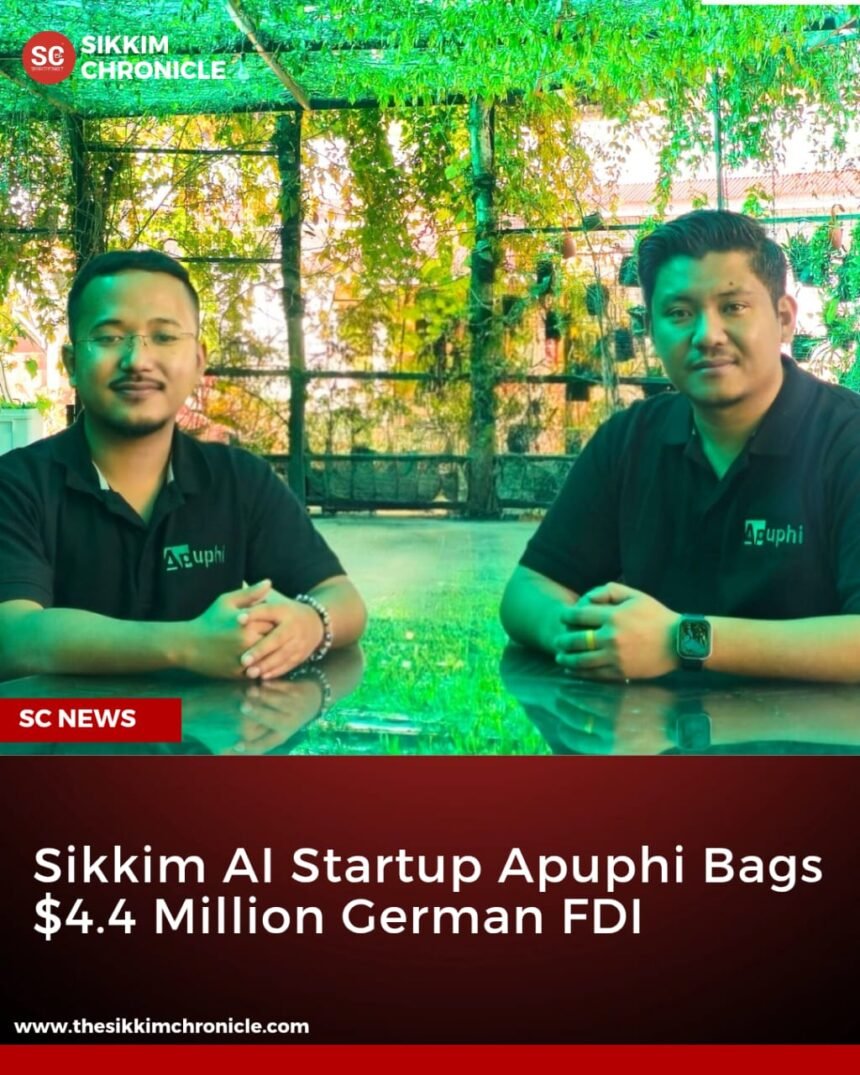
Apuphi, a Sikkim-based artificial intelligence career platform co-founded by Diwash Kapil Chettri and Sulabh Raj Gurung, has secured German Foreign Direct Investment at a valuation of USD 4.4 million. At a time when innovation narratives are still dominated by metro cities, Apuphi’s rise signals a quiet but powerful shift—one where world-class technology, ethical AI, and inclusive design can originate from the hills and scale globally.
Built on the belief that careers should not be left to chance, fragmented platforms, or privilege, Apuphi is reimagining how people discover jobs, transition careers, and grow with clarity and confidence. For co-founders Diwash Kapil Chettri and Sulabh Raj Gurung, this milestone is both a validation of their vision and a responsibility to prove that globally relevant AI innovation can be built from regions long considered outside India’s technology mainstream.
In this exclusive interview with SIKKIM CHRONICLE, the Apuphi founders reflect on their journey—from Sikkim to international investor confidence—while outlining their vision for India’s career ecosystem, responsible artificial intelligence, and the future of opportunity from smaller states and hill regions.

SC: Apuphi has secured German FDI at a valuation of USD 4.4 million. What does this milestone mean personally and professionally for the founding team?
Personally, the milestone is deeply humbling. Coming from Sikkim—a region rarely represented in India’s technology narrative—this investment feels like global recognition of years of belief, persistence, and unseen effort. Professionally, it validates our core thesis that meaningful AI innovation can emerge from anywhere, provided the problem is real and execution is disciplined. It also places a responsibility on us to build Apuphi to global standards while staying true to our roots.
What does the name “Apuphi” signify, and what values shaped the startup at inception?
“Apuphi” represents the idea of moving forward the right way. At its core is a simple but powerful cycle: apply, upskill, and get hired—meaningfully and sustainably. From day one, our values have centred on clarity, honesty, and long-term career growth. We never wanted to help people merely land jobs; we wanted to help them get hired for roles they are genuinely prepared for, with confidence and direction.
How did Apuphi come into existence, and what problem was it built to solve?
Apuphi emerged from shared personal experiences and repeated observations of people struggling in their careers—not due to lack of ability, but because the system around them was broken. Job portals focused only on listings, skilling platforms operated in isolation, and career transitions were left to guesswork. This fragmentation affected fresh graduates, professionals switching domains, and skilled blue-collar workers alike. Apuphi was created to unify careers into a single platform, making job discovery, learning, mentorship, and opportunity access simpler, clearer, and more effective.
How did German investors discover Apuphi, and what convinced them to invest in a Sikkim-based AI startup?
The investors discovered Apuphi through global founder–investor networks and were immediately drawn to the clarity of the problem we are solving. What convinced them was our understanding of universal gaps in the career ecosystem—lack of feedback, inefficient hiring, and poor career transitions—combined with Apuphi’s potential to scale globally. They recognised that this is not a regional issue, but a global one.
How is the foreign investment structured, and how does it comply with Indian regulations?
The investment is structured through Series-I Compulsorily Convertible Preference Shares (CCPS), in compliance with Indian FDI policy and FEMA regulations. It follows approved valuation norms, sectoral guidelines, and statutory reporting requirements, ensuring full regulatory transparency and long-term alignment between founders and investors.
What core challenges in India’s employment ecosystem is Apuphi addressing through AI?
India does not have a talent problem—it has a clarity and coordination problem. Millions apply blindly to jobs without feedback or guidance. Skills are acquired without alignment to real roles, and job portals disengage once applications are submitted. Apuphi uses AI to bring structure and direction to the career journey—helping users understand what to apply for, why they were rejected, what to improve, and what their next best step should be.
How does Apuphi differentiate itself from existing job portals and skilling platforms?
Most platforms operate in silos. Apuphi integrates jobs, skills, feedback, mentorship, and task-based work into one intelligent workflow. Our AI understands a user’s skills, gaps, career goals, and progress over time. We are not optimising for applications; we are optimising for outcomes—better transitions, real jobs, and sustained career growth.
How does Apuphi ensure inclusivity, particularly for blue-collar workers and users from smaller towns?
Inclusivity begins with design. Apuphi does not assume polished resumes, fluent English, or corporate exposure. Blue-collar and task-based roles are treated as first-class opportunities. The platform prioritises skills, intent, and experience over degrees, ensuring that opportunity is not limited by geography, background, or formal credentials.
What role do data ethics and responsible AI play in your technology stack?
Careers are deeply personal, and we treat them as such. Users own their data, transparency is non-negotiable, and our AI is designed to assist—not replace—human decision-making. We avoid opaque scoring systems and focus instead on explainable insights and actionable feedback. Responsible AI is foundational to Apuphi, not an afterthought.
As Apuphi scales nationally and globally, how important are its roots in Sikkim?
Sikkim is not just where Apuphi started—it is why Apuphi exists. Building from a remote region exposed us to real gaps and invisible barriers in India’s career ecosystem. Retaining our roots keeps us grounded and ensures we build for reality, not assumptions. Sikkim remains our proof that world-class AI companies can emerge from anywhere.
How can Apuphi contribute to high-value employment in Sikkim and the Northeast?
Apuphi’s biggest contribution is access—access to clarity, skills, remote work, and global opportunities without the need to migrate. Over time, it also creates local roles across AI operations, content, mentorship, and platform support, building a sustainable talent ecosystem within the region.
How significant is the state government’s move towards a formal AI policy?
It is a landmark development. A state-level AI policy signals institutional recognition of innovation beyond metro cities. For startups like Apuphi, it provides alignment, legitimacy, and long-term confidence to build locally while scaling globally.
How will the $4.4 million funding be deployed?
The focus is depth before scale. Capital will primarily be invested in strengthening our AI core, career intelligence systems, and feedback engines, alongside building a lean, high-quality team. Growth will be pilot-led, feedback-driven, and partnership-oriented.
When will Apuphi launch publicly, and what will users see first?
The public rollout will take place in phases, with accessibility expected by mid-2026. The first phase will focus on AI-driven job discovery, application tracking, interview preparation, and personalised skill-gap insights. Advanced features will follow once the core platform is stable and trusted.
What message does Apuphi’s journey send to entrepreneurs from smaller states and hill regions?
Innovation is not limited by geography. Apuphi demonstrates that ambition, clarity of purpose, and resilience matter more than pin codes. If a team from a Himalayan state can build a globally relevant AI platform and attract international investors, then the next wave of India’s innovation can truly come from anywhere.
